Cases / Enterprise Simulation · 2018
Laboratory Fire Response and Electrical Safety
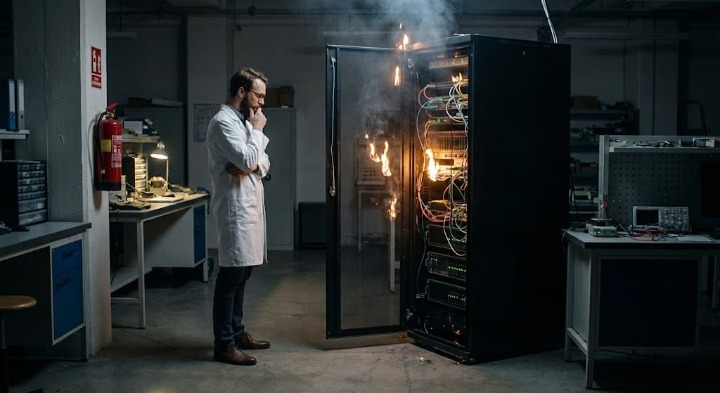
A branching VR simulator that trains the decision — CO₂ on live equipment or cut the power first — with crawl, walk, run learning modes.
RoleSenior Product Owner / Lead Project Manager, Jasoren
Period2018
DomainLaboratory safety training
StackVR, Unreal Engine, branching scenario logic
Context
Laboratories hold expensive, sensitive equipment, often under high voltage. A generic fire response is dangerous: foam on live electronics can electrocute the responder, while shutting down critical power unnecessarily can ruin experiments. Traditional training rarely lets personnel practise these split-second trade-offs.
My role
I managed development of a procedural VR simulator focused on decision accuracy rather than rote memorisation.
What I did
- Assess, then act. The trainee has to check whether the equipment is energised, then perform the full actuation sequence (for example the PASS method or fire-blanket draping).
- Non-linear solutions. An electrical fire has two valid paths: use a non-conductive CO₂ extinguisher on live equipment, or find the emergency kill switch, cut the power and then use foam. Using foam on live equipment triggers an immediate electrocution event.
- Crawl–walk–run learning. Mode 1 is a VR tutorial sandbox, Mode 2 is guided practice with holographic overlays, Mode 3 is an examination with all aids removed and an evaluator view on an external screen for instructors.
Result
- Moves training from memorised steps to understanding why a specific tool is chosen.
- Provides auditable proof that staff can handle fires involving energised equipment.